Introduction
Eating is only the beginning of the body’s food journey. Once a meal enters the mouth, a coordinated series of physical movements and chemical reactions begins. Different organs perform specialized jobs to turn food into smaller substances that the body can absorb and use.
The digestive system also decides what should be absorbed, what should remain in the intestinal tract, and what eventually needs to leave the body. This entire process happens continuously, often without conscious effort.
The Digestive System at a Glance
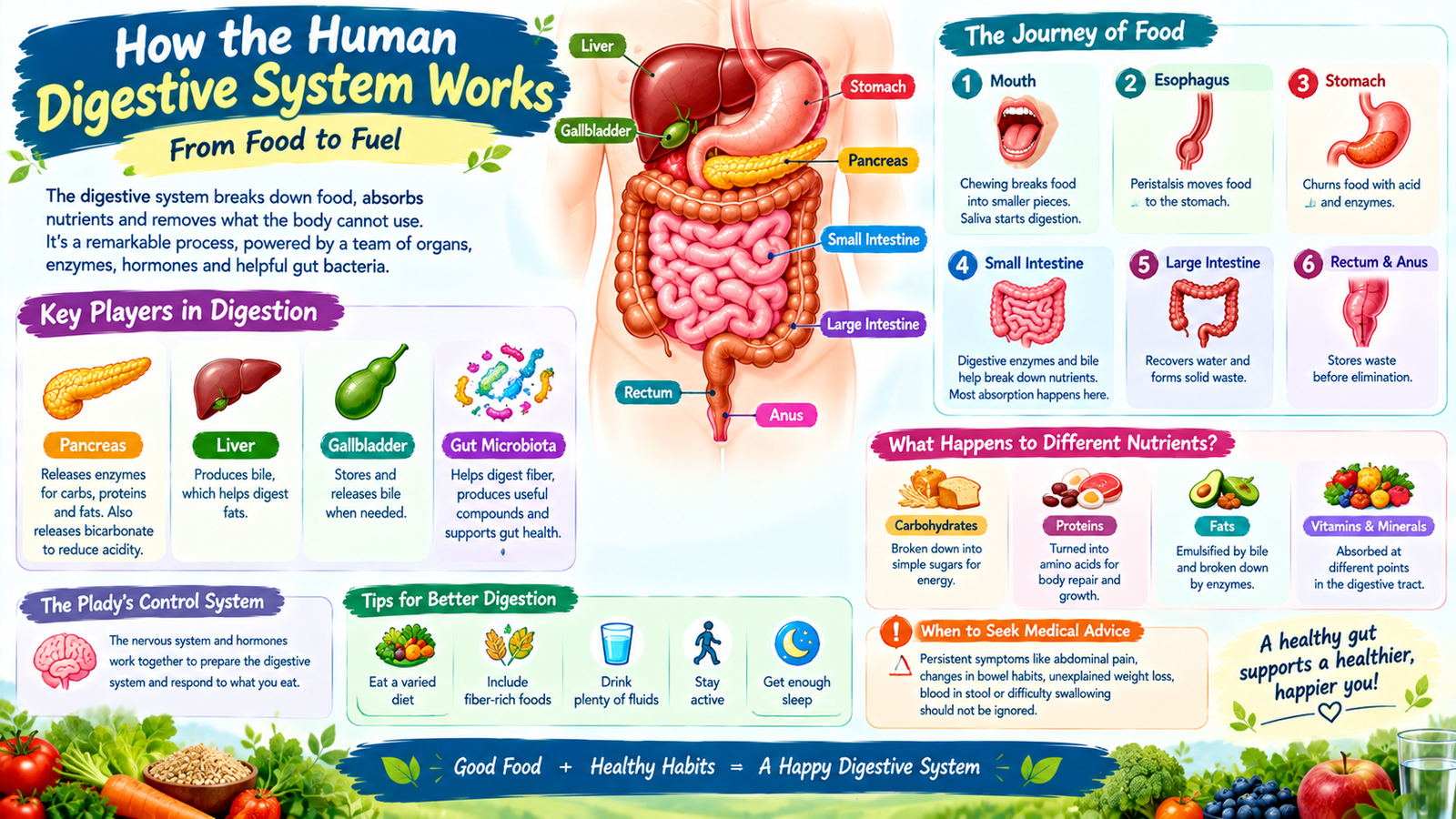
The digestive tract is a long passage running from the mouth to the anus. Its major sections include the mouth, esophagus, stomach, small intestine, large intestine, rectum, and anus.
Several organs located outside this main passage also contribute to digestion. The liver, gallbladder, and pancreas release substances that help the digestive tract process different components of food.
Each section has its own responsibility, but all of them operate as parts of one connected system.
1. The Mouth Starts the Process
Digestion begins before food reaches the stomach.
Teeth cut, crush, and grind food into smaller pieces. This increases the surface area available for digestive chemicals to act on. The tongue moves food around the mouth and helps prepare it for swallowing.
Saliva moistens the food and contains enzymes that begin working on certain carbohydrates. After chewing and mixing, the tongue pushes the food toward the throat.
2. The Esophagus Delivers the Food
Swallowing moves food from the mouth into the esophagus, a muscular tube connecting the throat with the stomach.
The esophagus uses rhythmic muscular contractions called peristalsis to move its contents downward. These contractions occur automatically and continue until the food reaches the stomach.
A muscular valve near the stomach helps reduce the backward movement of stomach contents into the esophagus.
3. The Stomach Temporarily Holds the Meal
The stomach serves as both a storage chamber and a digestive organ.
Its muscular walls repeatedly contract, mixing the meal with acidic digestive fluid. This turns the food into a semi-liquid mixture and begins further breakdown, particularly of proteins.
The stomach does not empty all its contents into the intestine at once. Instead, it gradually sends small portions onward, allowing the next stage of digestion to proceed in an organized manner.
4. The Pancreas Supplies Powerful Digestive Helpers
Once the partially digested food reaches the small intestine, the pancreas becomes especially important.
It releases enzymes capable of breaking down carbohydrates, proteins, and fats. These enzymes reduce large food molecules into smaller components that the intestinal lining can absorb.
The pancreas also supplies bicarbonate, which helps reduce the acidity of material arriving from the stomach. This creates a more suitable environment for intestinal digestion.
5. The Liver and Gallbladder Assist With Fat Digestion
The liver produces bile, a digestive fluid that helps the body handle dietary fats.
Bile is stored in the gallbladder between meals. When fatty food reaches the small intestine, the gallbladder can release bile into the digestive tract.
Bile breaks large fat droplets into much smaller droplets. This process makes it easier for fat-digesting enzymes to work effectively.
6. The Small Intestine Does Most of the Absorbing
The small intestine is the main location where nutrients pass from digested food into the body.
Its inner surface contains numerous folds and tiny projections that greatly increase the available area for absorption. Nutrients such as sugars, amino acids, fatty components, vitamins, and minerals can then enter circulation through specialized pathways.
The small intestine is therefore not simply a tube that food passes through. It is a highly active region where the products of digestion become available to the rest of the body.
7. Different Foods Follow Different Chemical Routes
The body handles major nutrients in different ways.
Carbohydrates are reduced into simple sugars that can be absorbed and used as energy.
Proteins are separated into amino acids and smaller components needed for tissue maintenance and other biological functions.
Fats are processed with the assistance of bile and enzymes before their components can be absorbed.
Vitamins and minerals follow their own absorption pathways depending on the particular nutrient.
8. The Large Intestine Handles the Remaining Material
After the small intestine has absorbed most usable nutrients, the remaining contents move into the large intestine.
One important job of the large intestine is reclaiming water and certain electrolytes. As water is removed, the material gradually becomes more solid.
This section of the digestive tract is also home to a large population of microorganisms collectively known as the gut microbiota.
9. Gut Microbes Have Their Own Role
Not every component of food can be completely processed by human digestive enzymes. Certain types of dietary fiber reach the large intestine largely intact.
Gut microorganisms can ferment some of these materials and produce compounds that interact with the intestinal environment.
The makeup of the gut microbiota differs from person to person and can be influenced by diet, medications, age, lifestyle, and other factors.
10. The Final Stage Is Waste Removal
Once the body has recovered useful nutrients and water, the remaining material becomes fecal matter.
It moves into the rectum, where it can be stored temporarily. When the appropriate signals occur, the body eliminates it through the anus.
This completes the digestive journey.
How Digestion Is Controlled
Digestion is not simply a sequence of organs working independently. The nervous system and digestive hormones coordinate many of the activities involved.
Signals can influence stomach contractions, intestinal movement, digestive-fluid production, and the release of substances from the pancreas and gallbladder.
The digestive tract can also respond to the physical and chemical characteristics of the food passing through it.
Habits That Support Digestive Function
The digestive system generally benefits from a healthy overall routine.
Some practical habits include:
- Eat a varied selection of foods.
- Include fiber-rich foods regularly.
- Drink an appropriate amount of fluid.
- Chew food thoroughly.
- Remain physically active.
- Get adequate sleep.
- Avoid excessive alcohol consumption.
- Use medications according to professional guidance.
- Introduce major dietary changes gradually.
There is no need for routine detox drinks or cleansing programs to “remove toxins” from the digestive tract. The body already has natural systems for processing and eliminating waste.
When Digestive Changes Deserve Attention
Digestive discomfort can occur occasionally for many ordinary reasons. However, symptoms that persist or become severe should not simply be ignored.
Ongoing abdominal pain, repeated vomiting, unexplained weight loss, blood in the stool, persistent diarrhea, prolonged constipation, or difficulty swallowing can require professional evaluation.
These symptoms can arise from many different conditions, so identifying the actual cause is more useful than assuming that a particular food or digestive organ is responsible.
Conclusion
The digestive system is an interconnected network that transforms a meal into substances the body can use. The journey starts with chewing in the mouth, continues through muscular movement and chemical digestion, and eventually reaches the stages where nutrients and water are absorbed and leftover material is removed.
The stomach, small intestine, large intestine, liver, gallbladder, pancreas, nervous system, hormones, and gut microorganisms all contribute to this remarkable process.
Supporting digestion is less about finding a single “superfood” and more about maintaining sensible habits over time. A varied diet, sufficient fiber and appropriate hydration, regular movement, adequate rest, and attention to persistent symptoms can all contribute to digestive well-being.
Verification Code: DG8Q5XM42LR